Summary: The guide explains how to create an efficient AI marketing strategy for 2026, including agentic AI, generative AI marketing, AEO vs GEO, and lead generation techniques US companies can apply to maintain visibility through both standard and AI search.
___________________________________________________________________
How to Create an AI Marketing Strategy for Business Growth
Digital Marketing | AI SEO Services | AI Marketing Tools
Such a marketing approach through AI will consist of joining a human-driven marketing plan to an AI-driven execution. It is an integration of tools, processes, and search optimization in AI marketing, rather than being treated separately. Companies that try to apply AI as an add-on have no visible results. It is the companies that integrate AI in digital marketing strategy that achieve success. This way of AI application is particularly necessary in 2026. According to research for 2026, 67% of small and medium-sized firms apply AI in marketing operations, and 60% of marketers utilize AI-based tools daily. According to HubSpot, 61% of marketers find this industry to be the biggest disruption during the past 20 years.
What is AI Marketing?
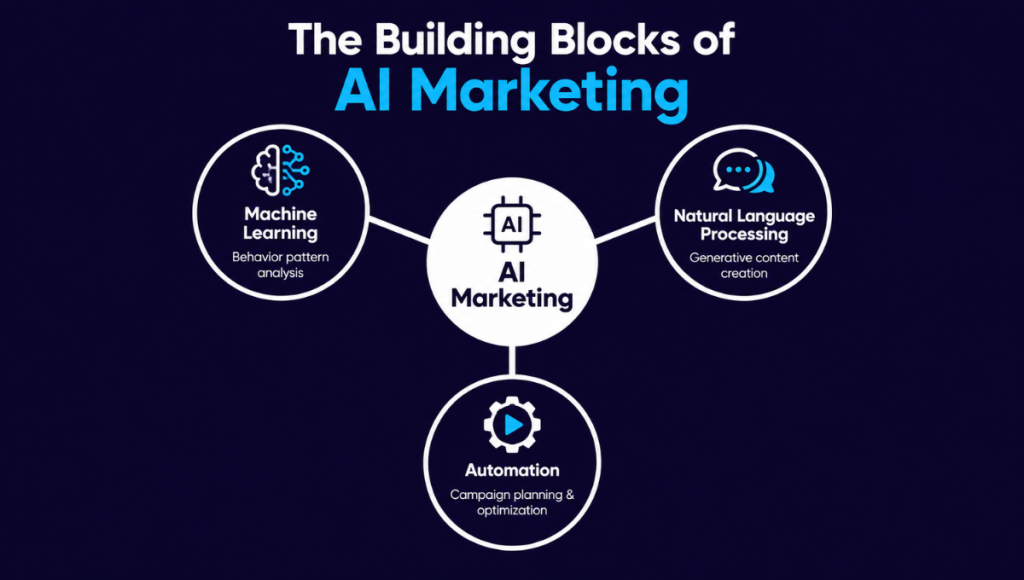
AI marketing leverages machine learning, natural language processing, and automation to plan, produce, and optimize campaigns. It transforms assumptions into data-driven decisions. No need to manually segment audiences when behavior analysis can be done in real-time. No need to create each asset individually since generative AI marketing software generates copywriting. It does not mean that the marketer becomes unnecessary in the process. On the contrary, their function becomes more strategic than operational.
Reasons Why the Trends in AI Marketing in 2026 Call for a Novel Strategy
AI technology is no longer in the experimental phase. Adoption of AI technology by enterprises is currently the norm in most industries. Almost 83% of enterprises have already embraced AI in their marketing processes, according to Adobe. Nevertheless, adoption does not necessarily mean success. There are few companies that realize tangible benefits from the application of AI technology. The main difference lies in the strategy rather than the tools used.
Marketing with Agentic AI – The Future
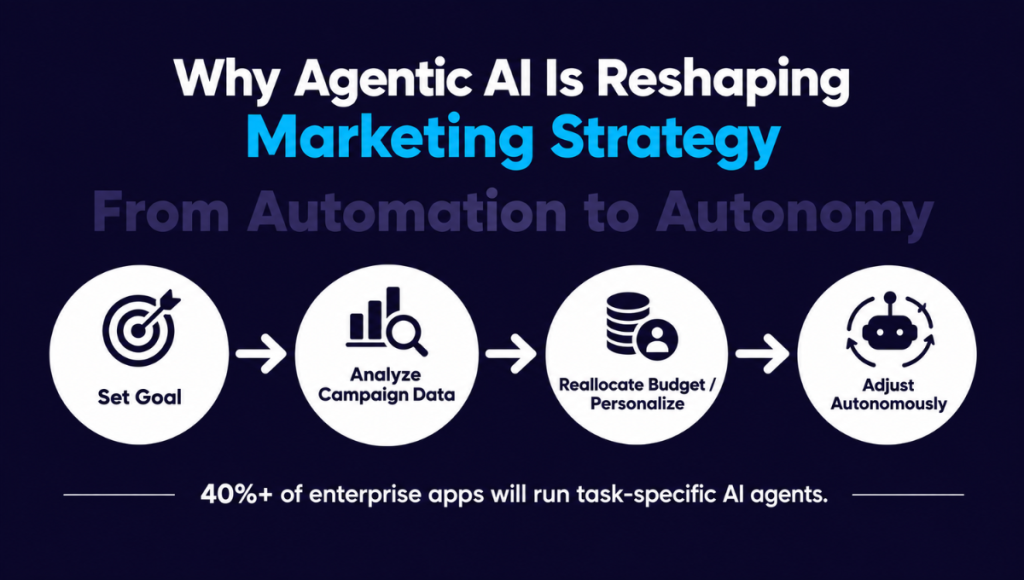
Agentic AI in marketing will be the next big thing. Unlike mere automation, agentic systems have goals to achieve and change course based on their own analysis. These systems are able to evaluate campaign efficiency, redistribute the budget, and make personal interactions autonomously with limited human involvement. Marketing departments use these systems more and more often in order to make timely decisions. According to industry statistics, more than 40 percent of enterprise solutions will feature task-oriented AI agents by the end of 2026. This is an eightfold increase compared to the previous year.
Key Components in Developing a Successful AI Marketing Strategy
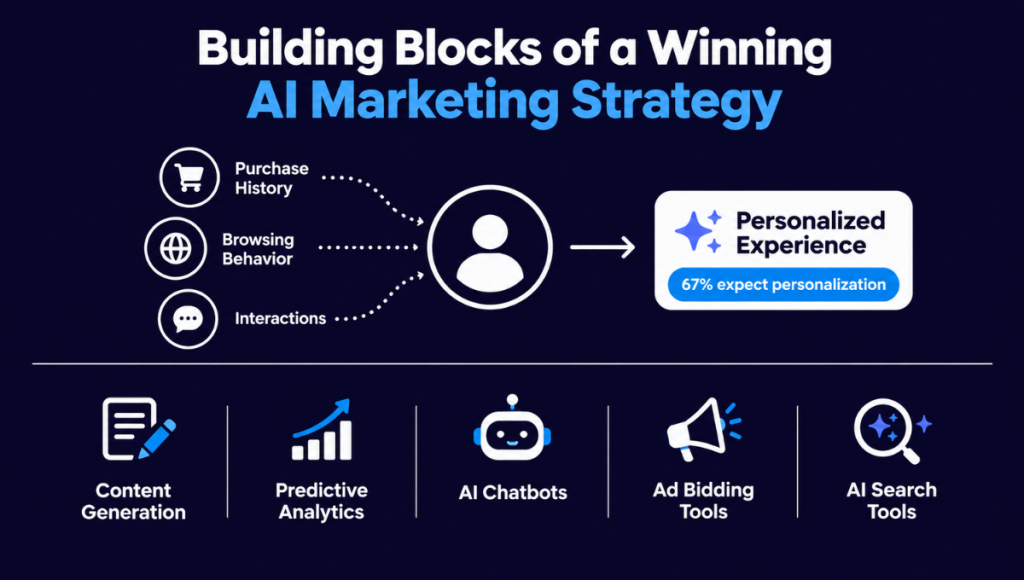
Having a marketing strategy does not merely entail using a chatbot on your company’s website. There is a lot more to it.
AI Marketing Strategies for Personalization
Before, personalization only meant adding someone’s first name in an email address. However, AI marketing strategies can take this further by analyzing one’s purchase history, online behavior, and interactions. This creates a content experience that changes from user to user and not just from segment to segment. This increases the click-through and conversion rate. According to Adobe, 67% of consumers expect this kind of personalized experience nowadays.
Marketing AI Tools for Your Toolbox
Since there are many different needs when it comes to marketing tools, many organizations use a variety of AI marketing tools. These may include:
- Content generation and editing tools
- Predictive analytics and audience insight tools
- Generative AI chatbots for customer service and lead generation
- Ad bidding and budget allocation algorithms using AI
- SEO and AI search optimization tools
Choosing tools that work well with your existing CRM and analytics systems is more important than picking the latest release version.
Implementation of Your AI Marketing Strategy
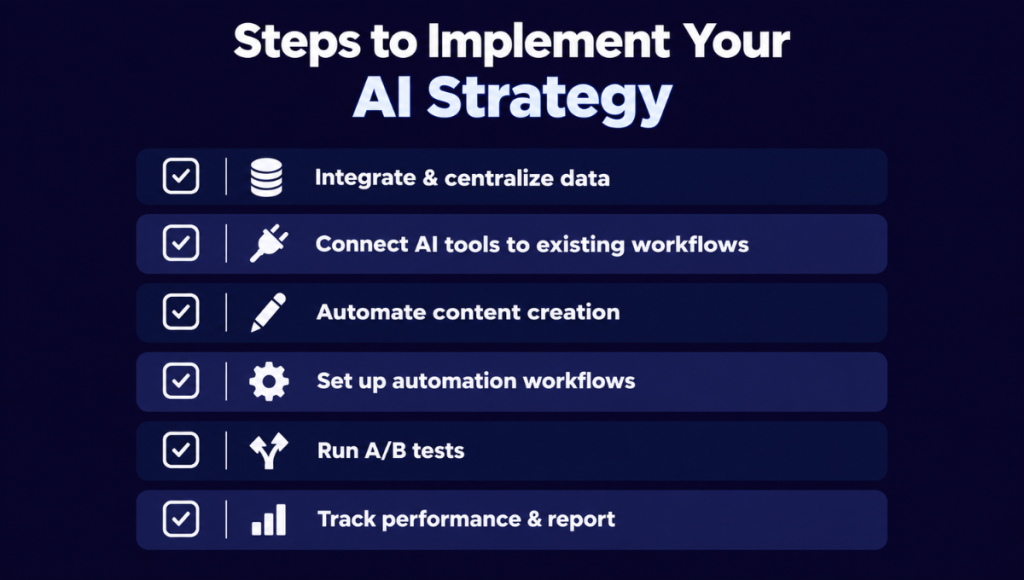
After the completion of planning, it’s time for execution. To make the strategy work, you need some structures in several important spheres.
Data Integration and Management
AI may give useful audience insights only if it has access to proper centralized data. In fact, almost every brand has first-party data collected from various channels. To become available, this data should be brought together in one CRM system. Modern CRMs often have built-in AI integration. Thus, you get all your data in one place, which is automatically analyzed for valuable insights.
Tools and Technologies Implementation
The most useful tools and technologies should integrate into the current process directly rather than being additional ones. This is crucial because AI needs all necessary data and assets for successful functioning. For example, an embedded AI can provide follow-up materials after the webinars, reveal audience behavior, and even moderate Q&A sessions.
Content Creation and Optimization
Content continues to stand out as a definite use case for AI marketing tools. AI-based content marketing software can create blog articles, newsletters, and social media post descriptions much quicker than humans would. Some companies choose to fully automate their secondary content creation through such platforms, while others still employ editors who review AI drafts. In either case, significant savings in production time are achieved.
Automation of Marketing Campaign Workflows
Automation ensures that campaigns run on a regular basis, and the team gains additional capabilities to focus on other tasks. Several marketing workflows are made quicker by using AI. For instance, audience segmentation can happen automatically according to predetermined parameters. Cart abandonment email messages can be sent off without scheduling, allowing you to win back lost clients.
Testing and Experimenting
The introduction of AI in a marketing strategy does not necessarily lead to desired outcomes on its own. Testing is a must, just like in other strategies, and in order to test it, you can implement the practice of A/B testing. It allows comparing AI-created materials with human-written ones and choosing a better one for further optimization.
Performance Evaluation and Reporting
A thorough reporting process helps complete an AI marketing campaign. It shows you what is effective, what is not, and how to change that. The value of reporting is best understood in the initial stages of AI integration. Knowing how AI affects your results can significantly simplify future choices.
AI Search Optimization: A New Level of Discovery
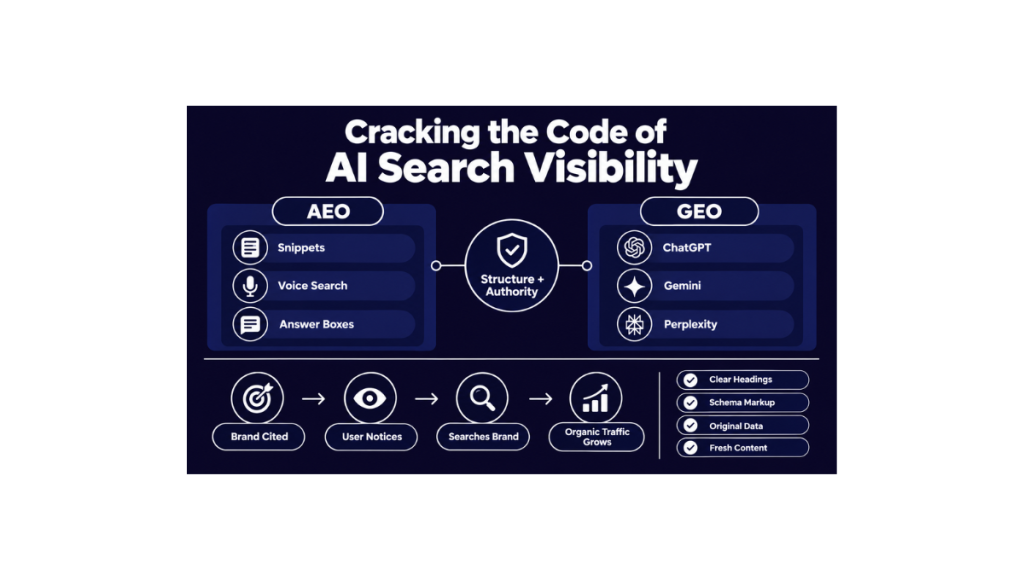
The discovery process is irrevocably altered. Now, buyers ask their questions right in ChatGPT, Gemini, and Google AI Overview. That’s why AI search optimization is crucial alongside conventional SEO techniques. Generative AI SEO is at the core of this transition because it looks at the discovery, comprehension, and referencing of content by AI algorithms rather than its mere crawling by traditional bots. Not being represented in these answers from AI is equal to missing an opportunity for visibility when people search.
AEO vs GEO: What is the Difference?
Marketers frequently confuse AEO and GEO, believing that the terms refer to the same process. However, AEO, or Answer Engine Optimization, concentrates on acquiring featured snippets, voice results, and answer boxes. GEO, or Generative Engine Optimization, centers on obtaining citations in answers generated by AI tools such as ChatGPT and Perplexity. Here is the difference table.
| Factor | AEO | GEO |
| Primary goal | Win the direct answer box | Earn citations in AI-generated answers |
| Target surfaces | Featured snippets, voice search, PAA boxes | ChatGPT, Gemini, Perplexity, AI Overviews |
| Content format | Concise Q&A, structured data | Authoritative, well-cited long-form content |
| Success metric | Snippet capture rate | Citation and mention frequency |
Even though there are differences, most organizations should not think of them as separate budgets. There is a lot of overlap between these two processes.
How AI Search Engine Optimization Tools Drive Organic Traffic
AI search engine optimization tools measure a different set of signals compared to old-fashioned SEO software. They measure how frequently a brand is cited within an AI answer and not where it ranks. In many cases, this visibility can drive traffic without requiring any clicking. A user sees a brand name within a credible AI response and then searches for that brand independently. The branded search then generates organic traffic through regular channels.
AI Search Engine Optimization Tips
AI search engine optimization begins with structure. Headings, clear answers, and list format can all assist models in understanding your content. Schema helps to make the structure readable by machines. It is necessary to demonstrate expertise as well; this means that the content cannot be just an ordinary summary but must have some original data, case examples, or research. Lastly, it is essential to keep your content up-to-date, as the AI algorithms prioritize the freshness of sources.
AI Strategy for Lead Generation
Targeting the audience at the correct time and the right way was crucial for lead generation even before the AI era. Now, it has become much more precise thanks to AI technologies.
Lookalike Modelling and AI Keyword Research
Lookalike modelling finds potential clients among users similar to those already targeted in some way. This process involves scanning thousands of data points using AI algorithms and, thus, saves you from spending money on poorly targeted ads. At the same time, AI keyword research makes finding intent-based keywords faster than ever before.
How We Create an Effective AI Marketing Strategy at TechBuzz Global
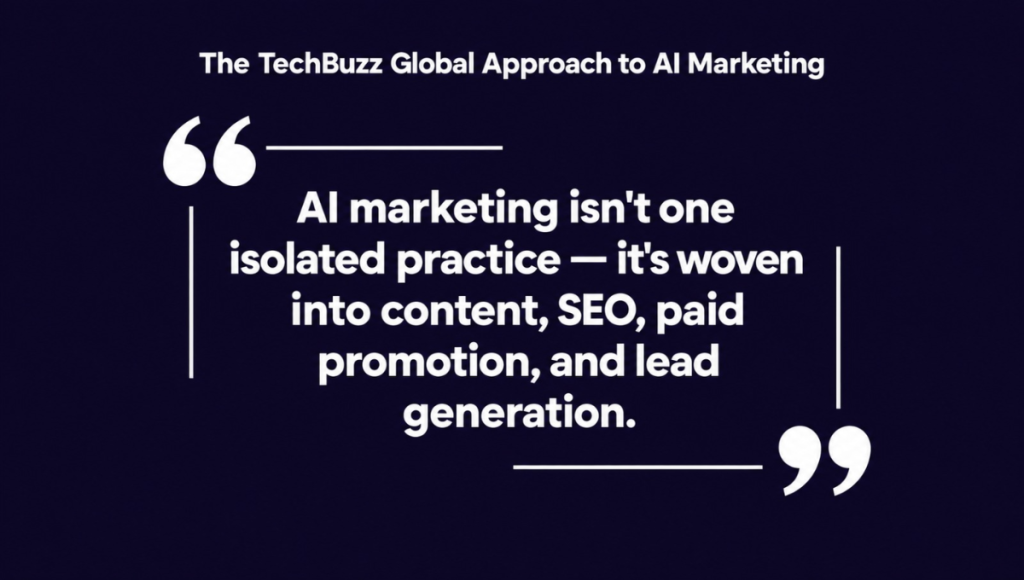
We don’t view AI marketing as one isolated practice at TechBuzz Global but include it in the entire strategy, including content and AI marketing, SEO, paid promotion, and lead generation. We combine the use of generative AI marketing workflows with professionals who can craft a strategy according to the specific brand voice and market realities. Also, we monitor how our strategy performs not only from the point of SEO practices but also from the new GEO signals. Whatever you may require. Developing an AI marketing strategy from scratch or fine-tuning your existing strategy, explore more strategies like this on our blog.
Conclusion
AI marketing strategy for 2026 is not an option but a requirement for businesses to survive the competition in the US market. Customers now use AI-driven searches alongside conventional search platforms. Agentic AI, generative content, and targeted reach are now necessities. Those organizations that develop an effective strategy covering these aspects will beat their competitors who are still testing these things. There is no need to develop a whole new strategy for this; just a well-defined plan and implementation are needed to make it happen. If you’re ready to build an AI marketing strategy that drives real results, get in touch with our team today.
Frequently Asked Questions
What is an AI marketing strategy?
An AI marketing strategy involves using artificial intelligence and automation to design and optimize marketing campaigns. It includes the use of AI technology and people.
What is the difference between AEO and GEO?
AEO is all about getting direct answer boxes and featured snippets. GEO is about getting citations from within AI-powered responses created by ChatGPT and other similar platforms. The requirements for content and structure are similar in both cases.
How does agentic AI impact the performance of marketing campaigns?
Agentic AI can set objectives and modify the strategy automatically, without the need for ongoing human involvement. It can analyze data and shift budgets according to performance metrics.